Riverside Drive
Earth AbidesRiverside Drive becomes a temporary refuge and a measure of the limits of survival in New York City. Ish finds Milt Abrams and Ann there while searching for somewhere to spend the night, and learns that the couple’s pleasant apartment sits at the center of a world they can scarcely leave. To Ish, the Drive is a route through a devastated city; to Milt and Ann, it is almost the whole city that remains.
Encounter on the Drive
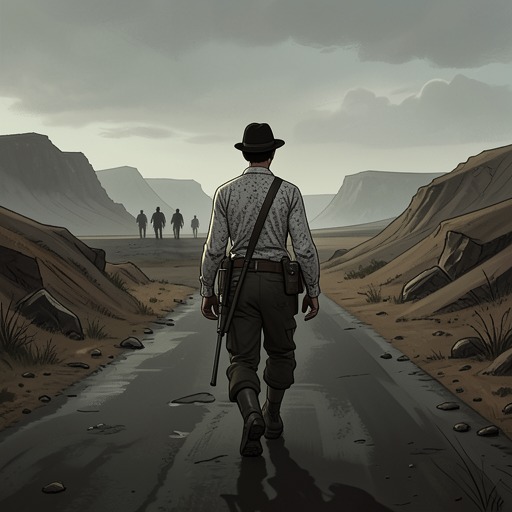
After crossing East Side streets and passing the areas around Bellevue Hospital and Pennsylvania Station, Ish turns north along Eleventh Avenue and then onto Riverside Drive. The sun is sinking over the smokeless smokestacks on the Jersey shore when a man calls to him from an apartment-house entrance. Princess erupts into barking in the car as Ish stops and goes to meet him. The man, middle-aged, overweight, neatly shaved, and still wearing a tropical suit, introduces himself as Milt Abrams.
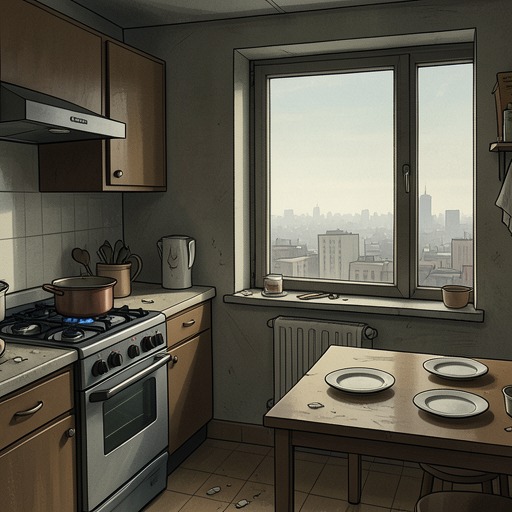
Milt takes Ish to a pleasant second-floor apartment. Ann is there beside a cocktail shaker, and Milt introduces her as his wife, though his hesitation exposes the awkwardness beneath the label. Ann had been married to Harry, and the catastrophe has left no opportunity for a formal ceremony between her and Milt. The domestic scene is orderly and hospitable, but its conventions cannot quite conceal how radically their circumstances have changed.
A Small World Within New York
Milt and Ann’s life on Riverside Drive is comfortable in its immediate details and constricted in its geography. Milt had part-owned a small jewelry store; Ann had sold perfume during the Christmas rush, more as a lark than a livelihood. They now occupy a fine apartment, better than the home Harry had been able to provide. Electricity failed soon after the disaster because New York’s dynamos had been steam-driven, but the water supply still worked, preventing an immediate sanitary crisis.
That comfort does not make the couple mobile. Neither had owned a car or learned to drive, automobiles are mysteries to them, and public transportation has disappeared. They are left on foot, with neither the age, temperament, nor physique to enjoy walking. Broadway’s stocked food and liquor stores mark their practical eastern limit; the river bounds them to the west. They wander perhaps half a mile north and south along the Drive. Within those narrow limits, they do not think anyone else is alive. The East Side seems as distant as Philadelphia, and Brooklyn as remote as Saudi Arabia.
Isolation and Departure
The Drive’s shelter is therefore also a boundary. Milt and Ann have not grasped the extent of what has happened elsewhere in New York; their knowledge of the wider city is even more limited than Ish’s. Their card-playing and ordinary domestic talk sustain a make-believe of life continuing beyond the apartment windows. Ish recognizes that they are living in the present rather than dwelling on either the distant past or the uncertain future, and accepts the quiet normality of their evening as fitting for them.
But Ish sees a danger their enclave cannot resolve. Like highly bred city animals, Milt and Ann have become specialized for a world that no longer functions. Their former occupations and comfortable urban habits have not equipped them to live off the land, unlike people Ish has encountered in Arkansas. Riverside Drive thus gathers the contrast between inherited urban dependence and adaptability into one intimate meeting: the apartment is still pleasant, the water still runs, and yet the couple’s world has shrunk to a few blocks.
As the Drive curves, Milt and Ann pass out of Ish’s sight even if he turns back. His eyes fill with tears as he leaves them behind and continues west, toward what he still thinks of as home. The farewell gives Riverside Drive a significance beyond its role as a stopping place: it is where Ish recognizes the human cost of isolation, and where a brief encounter ends without resolving the couple’s fate.